Social Studies and Research in Iran

Social Studies and Research in Iran


The journal of Social Studies and Research in Iran is an Open Access quarterly journal. This journal with the aim of publishing theoretical and experimental research in the field of social sciences in general and identifying the social problems of Iranian society and providing practical solutions for it in particular; It undertakes to publish research articles (derived from research projects and doctoral theses) and analytical articles. The received articles will be published after the initial approval of the editorial board and expert review. The journal follows the policies and guidelines of the Committee on Publication Ethics (COPE).


Publisher: University of Tehran Press

Publication sequence: Quarterly

Type of articles: Research and Review

Peer Review Policy: Double-blind peer-review

Initial review: Average 2 weeks.
Review and Acceptance time: Average 16 weeks

Publication type: Electronic

Plagiarism: Samim Noor, Hamtajo (Maximum similarity 15%)

Article Processing Charges: 20000000 Rials (Review fee 3000,000 Rials & Publication fee 17000,000 Rials)

COPE: The journal of Social Studies and Research in Iran  follows the policies and guidelines of the Committee on Publication Ethics (COPE) and abides by its Code of Conduct in dealing with potential cases of misconduct.
Copyright: Authors retain copyright, and the journal holds the right of first publication. 
Type of License: CC BY-NC 4.0 .

Open Access: There are no financial, legal, or technical barriers to access to articles in this journal


A memorandum of understanding was signed between The Quarterly of Social Studies and Research in Iran and the Iranian Sociological Association.


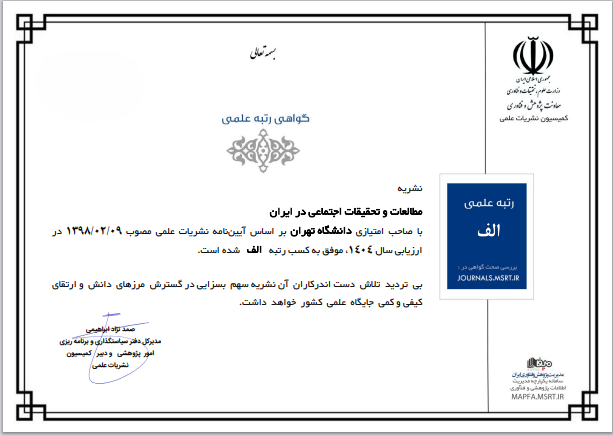
Guide to using artificial intelligence tools in research approved by the Ministry of Science, Research and Technology of the Islamic Republic of Iran


Current Issue: Volume 15, Issue 3, Autumn 2026 

Construction of Child Labor in the Context of Iran’s Virtual Space

Pages 45-64

10.22059/jisr.2026.406620.1689

Mohammad Abbaszadeh, Mohammad Bagher Alizadeh Aghdam, Tavakkol Aghayari Hir, Ali Zare

Publication Information

Indexing and Abstracting

Keywords Cloud

  • Iran
  • Social capital
  • Women
  • family
  • Grounded theory
  • Religiosity
  • gender
  • Identity
  • students
  • Representation
  • Thematic analysis
  • Tehran
  • University
  • participation
  • social trust
  • phenomenology
  • Development
  • Cultural Capital
  • Modernity
  • cyberspace
  • Religion
  • Governance
  • trust
  • Child Labor
  • Attitude
  • social participation
  • Gender
  • Generation
  • divorce
  • Lifestyle
  • Childbearing
  • Critical Ethnography
  • body
  • Social Health
  • Education
  • Migration
  • Globalization
  • Life Satisfaction
  • Media
  • Social Exclusion
  • Tradition
  • Social Inequality
  • Cinema
  • institutional trust
  • Street Children
  • Inequality
  • Socialization
  • Violence
  • security
  • Leisure Time
  • Tehran city
  • Social support
  • social networks
  • Student
  • crime
  • Loneliness
  • Typology
  • Ethnicity
  • iranian cinema
  • International migration
  • Sanandaj
  • Organizational Culture
  • Happiness
  • NGOs
  • Discourse analysis
  • social class
  • Privatization
  • Adolescent
  • social development
  • political tolerance
  • Market
  • sociology
  • Bureaucracy
  • poverty
  • Social Construction
  • Clothing
  • agency
  • Narrative Analysis
  • Motivation
  • Self-expression
  • Social network
  • Economic Capital
  • political culture
  • Kermanshah
  • Rational Choice
  • Civil society
  • discourse
  • power
  • youth
  • Mental Health
  • Family changes
  • habitus
  • Child
  • National Identity
  • Social Tolerance
  • Youth
  • Lived Experience
  • belief
  • climate change
  • Social Indifference
  • Social Factors
  • Internet
  • Conflict
  • critical discourse analysis
  • quality of life
  • modernization
  • Qualitative Method
  • Satisfaction
  • interactions
  • Fashion
  • Self-management
  • Democracy
  • Collective action
  • Environmental knowledge
  • Ferdowsi University of Mashhad
  • Ethnography
  • Segregation
  • fertility
  • Critical realism
  • Sociolinguistics
  • Meta-analysis
  • Tabriz
  • Employed Women
  • Qajar era
  • gender inequality
  • technology
  • field
  • cohabitation
  • Social Justice
  • environmental attitude
  • Types of Capital
  • female students
  • Collective Memory
  • Reforms
  • Energy
  • time
  • Twitter
  • Municipality
  • Values and Attitudes
  • Alcohol Use
  • modernism
  • Assimilation
  • gender equality
  • Sociology of religion
  • environment
  • Systematic review
  • welfare
  • resilience
  • historical sociology
  • hopelessness
  • Semiotics
  • Village
  • "social capital"
  • risk
  • Islamic Revolution
  • Urban Management
  • gender generalizability
  • religious
  • Graduates
  • Victimization
  • Mashhad
  • Yazd city
  • Development planning
  • city
  • Religious identity
  • social control
  • Isfahan
  • Religious Tolerance
  • development
  • Policy making
  • social policy
  • cultural development
  • Culture
  • Meta-synthesis
  • Neoliberalism
  • Social changes
  • Instagram
  • Mass Media
  • Ontology
  • Bourdieu
  • Demographic Changes
  • Content analysis
  • National survey
  • ethnic
  • Political Development
  • Covid-19
  • Socioeconomic Status
  • Narrative
  • Citizen participation
  • apathy
  • objects
  • Social distance
  • Individualism
  • Economic Development
  • Facilities
  • Social hope
  • Diversity
  • Religious Values
  • Return to Self
  • Informal sector